How does Wyoming compare to Connecticut for LLC formation?
Wyoming is the superior choice for non-resident LLC formation on every major comparison factor when measured against Connecticut. Connecticut costs more to form, more to maintain annually, imposes one of the highest state income tax rates in the nation, requires member disclosure in public records, and provides weaker single-member LLC asset protection.
Both states allow non-US residents to form LLCs without a Social Security Number, US address, or visa. The legal process is similar in both states: file formation documents with the Secretary of State, appoint a registered agent, and obtain an EIN from the IRS. The differences emerge in ongoing costs, tax obligations, privacy protections, and legal protections for LLC owners.
Wyoming enacted the first LLC statute in the United States in 1977. Connecticut adopted its LLC act in 1993. Wyoming has 49 years of LLC case law and statutory refinement, giving it the most mature and tested LLC legal framework in the country. Connecticut's LLC framework is newer and has less case law addressing critical issues like single-member LLC creditor protections.
Quick Comparison Overview
| Factor | Wyoming | Connecticut |
|---|---|---|
| Formation fee | $100 | $120 |
| Annual report fee | $60/year | $80/year |
| State income tax | 0% | 3% - 6.99% |
| Pass-through entity tax | None | Elective since 2024 (6.99%) |
| Privacy (member names) | Not in public records | Required in public filings |
| Single-member protection | Charging order (exclusive) | Limited protection |
| Processing speed | Immediate online | 4-6 business days |
| Non-resident friendly | Highly established | Allowed but less common |
| LLC statute established | 1977 (first in US) | 1993 |
Key fact: Connecticut is one of the highest-tax states in the nation. Its 6.99% top income tax rate makes it one of the most expensive states for profitable LLC owners with Connecticut income. Wyoming eliminates all state income tax obligations.
What does it cost to form an LLC in Wyoming vs Connecticut?
Wyoming charges $100 to form an LLC while Connecticut charges $120, making Wyoming $20 cheaper for initial formation. The fee difference extends to annual costs as well, with Wyoming consistently cheaper across the board.
Wyoming Formation Process and Fees
Wyoming LLC formation requires filing Articles of Organization with the Wyoming Secretary of State. The $100 fee covers the standard filing. Online submission is available through the Wyoming Secretary of State website at sos.wyo.gov. The Articles of Organization require: LLC name (must include "LLC," "L.L.C.," or "Limited Liability Company"), registered agent name and Wyoming street address, organizer name and address, and the effective date. No operating agreement is filed with the state, but banks require one for account opening.
Filed online, a Wyoming LLC is active as soon as the filing is completed; paper filings take up to 15 business days. The state charges $700 (next business day) or $1,400 (same day) to expedite eligible paper filings, but online formations are not eligible and do not need it. For a non-resident, the EIN and the bank account set the timeline, not the state filing. Learn more about Wyoming LLC cost in the full breakdown guide.
Connecticut Formation Process and Fees
Connecticut LLC formation requires filing a Certificate of Organization with the Connecticut Secretary of State. The $120 fee covers the standard filing. Online submission is available through the Connecticut Secretary of State's CONCORD business filing system. The Certificate of Organization requires: LLC name, registered agent name and Connecticut street address, principal office address, name and address of at least one organizer, and the management structure (member-managed or manager-managed).
Connecticut processes standard online filings in 4-6 business days. Expedited processing is available for an additional $50. Connecticut also requires LLCs to publish a notice of formation in a newspaper, though this requirement was simplified in recent years. Standard processing in Connecticut is slower than Wyoming.
First-Year Cost Comparison
| Cost Item | Wyoming | Connecticut |
|---|---|---|
| Formation filing fee | $100 | $120 |
| Annual report (Year 1) | $60 | $80 |
| Pass-through entity tax | $0 | Elective since 2024 (6.99%) |
| Registered agent | $25-$100 | $50-$200 |
| Online filing available | Yes | Yes |
| Processing time | Immediate online | 4-6 business days |
| First-year total | $185-$260 | $250-$400 |
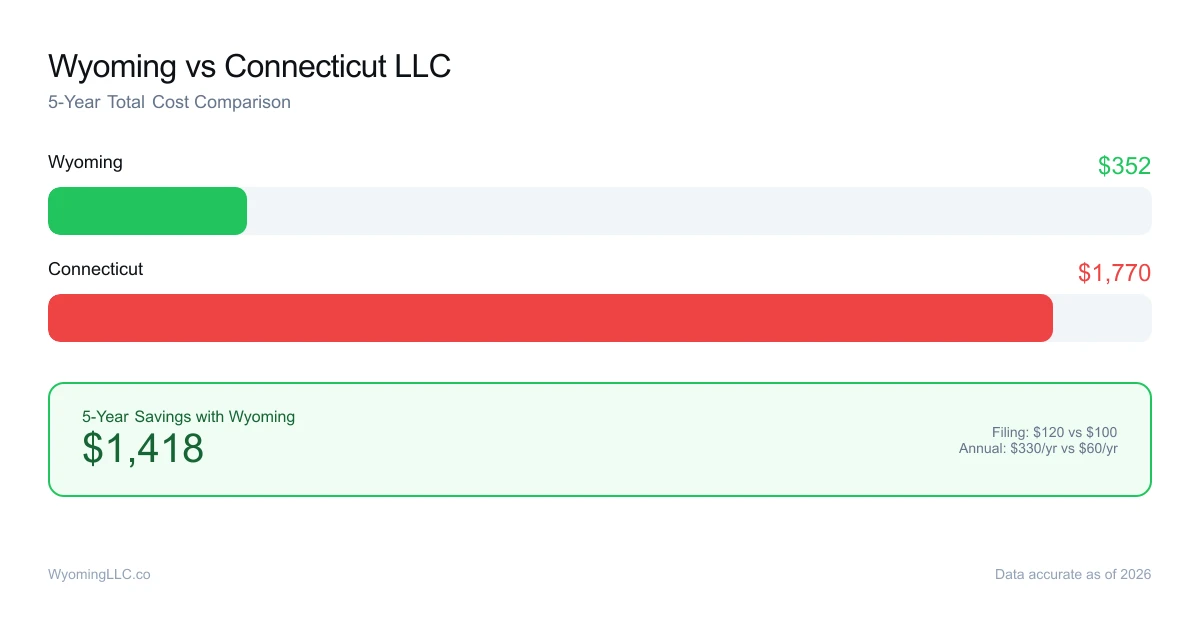
5-Year Total Cost Comparison
Over 5 years, the cost gap between Wyoming and Connecticut widens significantly. Wyoming's total state fees remain fixed and predictable. Connecticut's costs include annual report fees and potential state income tax that scales with revenue.
| Cost Item | Wyoming (5-Year) | Connecticut (5-Year) |
|---|---|---|
| Formation fee | $100 | $120 |
| Annual reports | $300 | $400 |
| Registered agent | $125-$500 | $250-$1,000 |
| State income tax ($0 income) | $0 | $0 |
| Total (no CT income) | $525-$900 | $770-$1,520 |
| Total ($100K CT income/yr) | $525-$900 | $35,720-$36,470 |
Even with $0 in Connecticut-sourced income, Wyoming saves $245-$620 over 5 years. With $100,000 in annual income, Wyoming saves approximately $34,800-$35,570 over the same period due to Connecticut's 6.99% top income tax rate. For a detailed breakdown of all state formation costs, see the state LLC fees comparison.
Form your Wyoming LLC with zero state income tax. $100 formation + $60/year. No pass-through entity tax.
Start on WhatsApp — FreeHow do Wyoming and Connecticut LLC taxes differ?
Wyoming has no state income tax, no corporate income tax, no franchise tax, and no pass-through entity tax on LLCs. Connecticut imposes a graduated income tax (3-6.99%), an elective pass-through entity tax (6.99%), and a state sales tax (6.35%).
Wyoming Tax Environment
Wyoming is one of seven states with no state income tax (along with Alaska, Florida, Nevada, South Dakota, Tennessee, Texas, and Washington). Wyoming also has no corporate income tax, no franchise tax, no inventory tax, and no gross receipts tax on LLCs. The only state-level cost for a Wyoming LLC is the $60 annual reportfee. This tax-free environment applies regardless of the LLC's revenue, profit, or number of members.
For non-residents, Wyoming's zero-tax status means the LLC's state of formation adds no tax burden. Non-residents only owe federal taxes (if applicable) and taxes in their home country. Learn about the full Wyoming LLC benefits including all tax advantages.
Connecticut Tax Environment
Connecticut imposes multiple taxes that affect LLCs:
- Individual income tax: Single-member LLCs pass income through to the owner. Connecticut's graduated rates range from 3% to 6.99% across seven tax brackets. The top rate of 6.99% applies to income above $500,000 for single filers.
- Pass-through entity tax (PET): A 6.99% entity-level tax on Connecticut-sourced income, mandatory through 2023 and elective for taxable years beginning on or after January 1, 2024. An LLC that does not elect it files a composite income tax return (Form CT-1065/CT-1120SI) for its nonresident members instead.
- Corporate income tax: LLCs taxed as corporations pay 7.5% corporate income tax in Connecticut, plus a 10% surcharge on tax liability exceeding $250, bringing the effective rate to 8.25%.
- State sales tax: Connecticut's state sales tax is 6.35%. Unlike many states, Connecticut does not have local sales taxes, so the rate is uniform across the state. LLCs selling goods in Connecticut must collect and remit sales tax.
- Property tax: Connecticut has high property taxes (average effective rate 1.63%, one of the highest in the US). LLCs owning real property in Connecticut pay property taxes at local mill rates.
Connecticut's pass-through entity tax is no longer mandatory, but an LLC with Connecticut-sourced income still has an entity-level filing: the elective PET return or the composite income tax return. Wyoming has neither.
Tax Comparison Table
| Tax Type | Wyoming | Connecticut |
|---|---|---|
| Individual income tax | 0% | 3% - 6.99% |
| Corporate income tax | 0% | 7.5% + 10% surcharge |
| Pass-through entity tax | None | Elective since 2024 (6.99%) |
| Franchise tax | None | None |
| Sales tax | 4% | 6.35% |
| Property tax (avg effective) | 0.56% | 1.63% |
Important: Connecticut's combined tax burden is among the highest in the nation. The 6.99% top income tax rate and entity-level composite or PET filing create significant tax obligations for profitable LLCs. Wyoming eliminates all state income tax obligations regardless of revenue level.
Which state offers better LLC privacy protection?
Wyoming offers significantly better privacy for LLC owners than Connecticut. Wyoming does not require member or manager names in public filings, while Connecticut requires disclosure of member and manager information in both formation documents and annual reports.
Wyoming Privacy Protections
Wyoming's Articles of Organization require only the LLC name, registered agent name and address, organizer name and address, and effective date. Member and manager names are not required and do not appear in any public filing. The Wyoming Secretary of State database shows only the LLC name, registered agent, filing date, and status.
Wyoming's annual report requires the names and addresses of the LLC's members or managers, but this information is filed with the Secretary of State and is accessible only through a detailed records request, not through the standard public online database search. Most Wyoming registered agent services use nominee organizers to further protect owner identity at the time of formation.
Connecticut Privacy Protections
Connecticut's Certificate of Organization requires the LLC name, registered agent name and address, principal office address, name and address of at least one organizer, and the management structure. Connecticut's annual reports require disclosure of member or manager names and addresses. This information is filed with the Connecticut Secretary of State and is accessible through the CONCORD public records search on the state website.
Connecticut does not offer privacy comparable to Wyoming. Member or manager names disclosed in formation documents and annual reports become part of the permanent public record. For non-residents who value privacy for personal security, competitive reasons, or compliance with home country regulations, Connecticut's disclosure requirements are a significant disadvantage.
| Privacy Factor | Wyoming | Connecticut |
|---|---|---|
| Member names in formation docs | Not required | Required (management structure) |
| Member names in annual report | Limited disclosure | Required for members/managers |
| Online public search shows members | No | Yes (CONCORD system) |
| Nominee organizer available | Yes (common practice) | Yes (less common) |
| Overall privacy rating | Excellent | Poor |
How does asset protection compare between Wyoming and Connecticut?
Wyoming provides explicitly stronger asset protection for LLC owners, especially single-member LLCs, through Wyoming Statute §17-29-503. Connecticut does not provide the same level of statutory protection for single-member LLC owners.
Wyoming Charging Order Protection
Wyoming Statute §17-29-503 establishes the charging order as the sole and exclusive remedy by which a judgment creditor of an LLC member can satisfy a judgment from the member's interest in the LLC. This means a creditor cannot:
- Seize LLC assets directly
- Force the LLC to make distributions
- Compel the LLC to liquidate
- Take over management of the LLC
- Foreclose on the member's LLC interest
Wyoming explicitly extends this protection to single-member LLCs. Many states provide charging order protection only for multi-member LLCs, leaving single-member LLC owners exposed. Wyoming's explicit protection for single-member LLCs is one of its most significant advantages and a primary reason non-residents choose Wyoming. Read the detailed guide on Wyoming LLC asset protection.
Connecticut Asset Protection
Connecticut's Uniform Limited Liability Company Act (Connecticut General Statutes §34-283) provides charging order protection for LLC members. However, Connecticut does not explicitly state that the charging order is the exclusive remedy for single-member LLCs. Connecticut courts have not definitively ruled on whether a creditor can use remedies beyond the charging order to reach a single-member LLC owner's interest.
This ambiguity creates risk for single-member LLC owners in Connecticut. A creditor with a judgment against the LLC owner could argue that Connecticut law allows foreclosure on the membership interest of a single-member LLC, effectively seizing the LLC. Wyoming eliminates this risk with its explicit statutory language.
| Asset Protection Factor | Wyoming | Connecticut |
|---|---|---|
| Charging order available | Yes | Yes |
| Exclusive remedy (multi-member) | Yes | Yes |
| Exclusive remedy (single-member) | Yes (explicit) | Unclear (no explicit provision) |
| Foreclosure on interest prohibited | Yes | Not explicitly prohibited |
| Case law strength | Extensive (49 years of LLC law) | Limited (33 years) |
Important: Asset protection is one of the top reasons non-residents form US LLCs. If you are forming a single-member LLC, Wyoming's explicit charging order protection provides significantly more certainty than Connecticut's ambiguous framework. This legal protection can mean the difference between keeping your business assets and losing them in a lawsuit.
What are the annual compliance requirements?
Wyoming requires one annual report per year with a $60 fee and no state tax returns. Connecticut requires an annual report ($80), a composite income tax return or elective PET return if the LLC has CT-sourced income, and potentially a state income tax return.
Wyoming Annual Compliance
Wyoming's annual compliance is straightforward. The only state-level requirement is the annual report, due on the first day of the month in which the LLC was formed. The report is filed online through the Wyoming Secretary of State website and takes approximately 10 minutes to complete. It requires updating the LLC's principal office address, registered agent information, and reporting the LLC's assets. The $60 fee is the same for all LLCs regardless of revenue or asset size (for LLCs with less than $300,000 in Wyoming assets).
There are no state tax returns to file in Wyoming. No quarterly estimated tax payments. No pass-through entity tax return. Wyoming's compliance burden is among the lowest in the United States. A missed filing results in a $50 late fee and potential administrative dissolution if the report remains unfiled for two consecutive years.
Connecticut Annual Compliance
Connecticut requires multiple annual filings:
- Annual report: Due on the anniversary of the LLC's formation. Filed with the Connecticut Secretary of State. Fee: $80. Requires updating member/manager names, addresses, and registered agent information.
- Composite income tax return (CT-1065/CT-1120SI): Required for pass-through entities with Connecticut-sourced income from taxable years beginning in 2024. An LLC may instead elect the 6.99% pass-through entity tax for the year and file Form CT-PET.
- State income tax return: Required if the LLC has Connecticut-sourced income or Connecticut-resident members. Due by April 15 (or the 15th day of the 4th month after the fiscal year ends). Tax rates: 3-6.99%.
- Estimated tax payments: An LLC that elects the PET makes quarterly estimated payments if it expects to owe more than $1,000.
Connecticut's compliance burden is significantly higher than Wyoming's. The combination of annual report, composite or PET return, and potential income tax return creates three separate filing obligations for an LLC with Connecticut income. Failure to file can result in penalties, interest charges, and administrative dissolution.
| Compliance Requirement | Wyoming | Connecticut |
|---|---|---|
| Annual report | $60/year | $80/year |
| Due date | Anniversary month | Anniversary date |
| Pass-through entity tax | Not applicable | Elective since 2024 (6.99%) |
| State income tax return | Not applicable | Required if CT income |
| Number of annual filings | 1 | 2-3 |
| Late penalty | $50 | Varies + interest |
| Filing complexity | Low (10 minutes online) | High (multiple returns) |
WyomingLLC.co includes registered agent, LLC formation, and EIN assistance for $297 + state fee.
Start on WhatsApp — FreeWhich state is better for non-US residents?
Wyoming is the clear winner for non-US residents forming a US LLC. Wyoming's established infrastructure for non-resident LLC owners, combined with zero state income tax, superior privacy, and explicit asset protection, makes it the default recommendation.
Why Non-Residents Choose Wyoming Over Connecticut
Wyoming has the most established infrastructure for non-resident LLC formation in the United States. Over 90% of non-resident LLC formation services recommend Wyoming as the default choice. The reasons are clear:
- Zero state income tax: No Connecticut-style income tax or pass-through entity tax at any revenue level
- Privacy: Member names stay out of public records, protecting owners from unwanted exposure in their home countries
- Asset protection: Explicit single-member charging order protection unavailable in Connecticut
- Banking access: Mercury Bank, Relay Bank, and Wise Business all accept Wyoming LLCs from non-residents
- Stripe compatibility: Full US Stripe access with 2.9% + $0.30 domestic processing rates
- Fast processing: immediate online filing vs Connecticut's 4-6 business days
- Simple compliance: One annual report ($60) vs Connecticut's 2-3 annual filings
- Lower costs: $25-$100/year for registered agent vs Connecticut's $50-$200/year
For a comprehensive analysis of why Wyoming leads for international LLC owners, read the guide on the best US state for LLC non-residents.
Non-Resident Formation Requirements
| Requirement | Wyoming | Connecticut |
|---|---|---|
| SSN required | No | No |
| US address required | No (use registered agent) | No (use registered agent) |
| US visa required | No | No |
| In-person visit required | No | No |
| EIN obtainable without SSN | Yes (fax Form SS-4) | Yes (fax Form SS-4) |
| Mercury/Relay banking | Accepted | Accepted |
| Stripe access | Accepted | Accepted |
| Non-resident experience | Highly established | Less common |
Both states allow non-residents to form LLCs and access US banking and Stripe. The formation requirements are identical. The differences are in cost, taxes, privacy, and protections. On every one of these factors, Wyoming outperforms Connecticut. Learn more at Wyoming LLC for non-residents.
What is the side-by-side comparison of Wyoming vs Connecticut?
The comprehensive comparison table below covers every factor relevant to choosing between Wyoming and Connecticut for LLC formation as a non-resident.
| Factor | Wyoming | Connecticut | Winner |
|---|---|---|---|
| Formation fee | $100 | $120 | Wyoming |
| Annual report fee | $60/year | $80/year | Wyoming |
| State income tax | 0% | 3-6.99% | Wyoming |
| Pass-through entity tax | None | Elective since 2024 (6.99%) | Wyoming |
| Corporate income tax | 0% | 7.5% + surcharge | Wyoming |
| Privacy (member names) | Not public | Public record | Wyoming |
| Single-member asset protection | Explicit | Unclear | Wyoming |
| Processing speed | Immediate online | 4-6 days | Wyoming |
| Annual filings required | 1 | 2-3 | Wyoming |
| Registered agent cost | $25-$100/year | $50-$200/year | Wyoming |
| 5-year cost (no income) | $525-$900 | $770-$1,520 | Wyoming |
| LLC statute maturity | 1977 (49 years) | 1993 (33 years) | Wyoming |
| Banking access | Mercury, Relay, Wise | Mercury, Relay, Wise | Tie |
| Stripe access | Full access | Full access | Tie |
Choose Wyoming If
- You are a non-US resident forming a US LLC for the first time
- You want zero state income tax at any revenue level
- Privacy is important and you want member names out of public records
- You are forming a single-member LLC and want explicit charging order protection
- You want the lowest total cost of ownership over 5 years
- You want simple compliance with one annual filing
- You want to avoid Connecticut's entity-level composite or PET filing
Choose Connecticut If
- You are a Connecticut resident with physical business operations in Connecticut
- Your business has employees, inventory, or an office in Connecticut
- You need to register in Connecticut regardless (forming there avoids dual registration and foreign LLC fees)
Recommendation: Non-residents with no physical presence in Connecticut should form a Wyoming LLC. Wyoming wins on 12 out of 14 comparison factors. The two ties (banking access and Stripe access) apply equally to both states. Wyoming saves $245-$620 in state fees over 5 years before considering Connecticut's 6.99% state income tax.
Frequently Asked Questions
Is Wyoming or Connecticut cheaper for LLC formation?
Wyoming is cheaper for both formation and annual maintenance. Wyoming charges $100 for formation and $60/year for the annual report. Connecticut charges $120 for formation and $80/year for the annual report. Over 5 years, Wyoming saves $245-$620 in state fees alone before accounting for Connecticut's 3-6.99% state income tax.
Does Connecticut have a state income tax on LLCs?
Yes. Connecticut imposes a graduated state income tax on LLC income with rates ranging from 3% to 6.99%. An LLC with Connecticut-sourced income also has a Connecticut filing obligation: since 2024 the 6.99% pass-through entity tax (PET) is elective, and an LLC that does not elect it files a composite income tax return instead. Wyoming has no state income tax and no pass-through entity tax.
Does Wyoming or Connecticut offer better LLC privacy?
Wyoming offers significantly better privacy. Wyoming does not require LLC member names in public filings. Only the registered agent and organizer appear in Secretary of State records. Connecticut requires disclosure of member and manager names in formation documents and annual reports, all of which are publicly accessible online through the CONCORD system.
Which state has better asset protection for single-member LLCs?
Wyoming has explicitly better asset protection for single-member LLCs. Wyoming Statute 17-29-503 provides charging order protection as the exclusive remedy for creditors of single-member LLC owners. Connecticut does not have the same explicit statutory protection for single-member LLCs.
Can non-residents form an LLC in Connecticut?
Yes. Connecticut allows non-US residents to form LLCs without a Social Security Number, US address, or US visa. The formation process requires a Certificate of Organization filed with the Connecticut Secretary of State, a registered agent with a Connecticut address, and the $120 filing fee. However, Connecticut lacks Wyoming's privacy and tax advantages.
What is Connecticut's pass-through entity tax?
Connecticut's pass-through entity tax (PET) is a 6.99% entity-level tax on Connecticut-sourced income. It was mandatory through 2023; for taxable years beginning on or after January 1, 2024 it is elective, chosen annually and irrevocably for that year. An LLC that does not elect it files a composite income tax return for its nonresident members instead. Wyoming has no equivalent.
How long does LLC formation take in Wyoming vs Connecticut?
Filed online, a Wyoming LLC is active as soon as the filing is completed, so no expedite fee is needed. Connecticut processes LLC filings in approximately 4-6 business days for standard submissions.
What is the 5-year total cost of a Wyoming LLC vs Connecticut LLC?
A Wyoming LLC costs approximately $525-$900 over 5 years ($100 formation + $300 annual reports + registered agent fees). A Connecticut LLC costs approximately $770-$1,520 over 5 years ($120 formation + $400 annual reports + registered agent fees). Connecticut's state income tax (up to 6.99%) adds thousands more for profitable LLCs.
Form your Wyoming LLC today. $100 formation, $60/year, zero state income tax, maximum privacy and protection.
Start on WhatsApp — Free