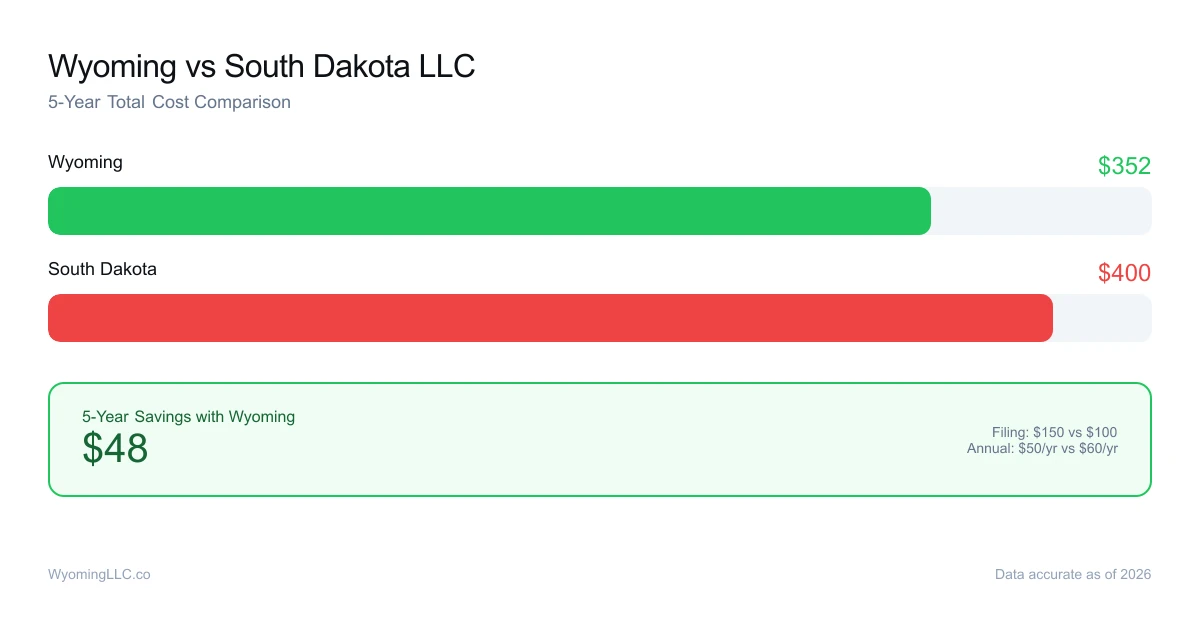
Which is cheaper to form: Wyoming or South Dakota?
Wyoming is cheaper to form: the Wyoming Secretary of State charges $100 for Articles of Organization (Wyoming fee schedule, effective July 1, 2026), while South Dakota charges $150 online or $165 on paper (South Dakota filing fees). That is a $50 saving on day one if you file online in both states.
The filing itself is similar. In Wyoming, the articles only have to state the LLC's name and its registered agent and registered office, and they are filed with the agent's written consent (W.S. 17-29-201). South Dakota's articles ask for more: the designated office address, the name and address of each organizer, whether the company is manager-managed and, if so, each initial manager's name and address (SDCL 47-34A-203). Both states take online filings through the Secretary of State; South Dakota's portal is linked from the SD SOS Business Services page.
Speed costs very different amounts. South Dakota lists a $50 expedite fee (SD fee schedule). Wyoming's expedited service is $700 for next business day and $1,400 for same business day (WY fee schedule), but it is meant for paper filings: an online Wyoming filing is processed by the state's system without it. When you order through us, the LLC is filed within 5 business days.
| Formation cost | Wyoming | South Dakota |
|---|---|---|
| Articles of Organization | $100 | $150 online / $165 paper |
| Name reservation | Optional, not required to file | $25 |
| Expedited processing | $700 next day / $1,400 same day | $50 |
| Owner names on the articles | Not required (W.S. 17-29-201) | Organizers always; managers if manager-managed (SDCL 47-34A-203) |
| Registered agent with in-state address | Required | Required |
What are the annual fees in each state?
South Dakota's annual report is slightly cheaper: $55 online or $70 on paper (SD fee schedule), against Wyoming's annual report license tax of $60 or two-tenths of one mill ($.0002) on the LLC's assets located and employed in Wyoming, whichever is greater (WY fee schedule).
For almost every non-resident the Wyoming figure is a flat $60. The $.0002 rate only exceeds $60 once an LLC holds more than $300,000 of property and assets in Wyoming itself; assets held elsewhere, including money in a bank account at a bank outside Wyoming or an online business run from abroad, are not counted under W.S. 17-29-209, which bases the fee on capital, property and assets "located and employed in the state of Wyoming".
Timing differs too. Wyoming's report is due on or before the first day of the month the LLC was formed, every year (W.S. 17-29-209). South Dakota's report is filed under SDCL 59-11-24 and the sections that follow it, and a late South Dakota report adds a $55 late fee (SD fee schedule). Miss a report in either state long enough and the LLC is administratively dissolved; reinstatement costs $100 in Wyoming for a tax lapse and $150 plus back reports and fees in South Dakota, per the two fee schedules.
Five-year state fee comparison
| Year | Wyoming (cumulative) | South Dakota online (cumulative) |
|---|---|---|
| Year 1 (formation) | $100 | $150 |
| Year 2 | $160 | $205 |
| Year 3 | $220 | $260 |
| Year 4 | $280 | $315 |
| Year 5 | $340 | $370 |
This counts state fees only: one formation filing plus four annual reports. It leaves out the registered agent, which you need in either state, and assumes Wyoming's $60 minimum. Wyoming starts $50 ahead and gives back $5 a year, so South Dakota only draws level after ten annual reports. File South Dakota on paper and it never catches up. For every state side by side, see the state fees comparison.
Which state keeps LLC owners more private?
Wyoming keeps owners more private, because its public filings never have to name a member or manager. The articles carry the LLC name and registered agent (W.S. 17-29-201), and the annual report carries the principal office address and Wyoming assets (W.S. 17-29-209). The person who signs as organizer can be the formation service, so the owner's name does not have to appear on the public record at all.
South Dakota asks for more on both documents. The articles must give the name and address of each organizer and, for a manager-managed LLC, each initial manager (SDCL 47-34A-203). The annual report must list the names and business addresses of the company's governors, with an exception for member-managed LLCs, which do not have to list them (SDCL 59-11-24). A member-managed South Dakota LLC with a service acting as organizer can therefore keep members off its filings too, but it has to be set up that way deliberately, and a manager-managed one cannot.
Privacy on the state register is not secrecy. In both states your bank, your registered agent and the IRS know who owns the LLC: the bank under its know-your-customer rules, the IRS through the EIN application and, for a foreign-owned single-member LLC, Form 5472. What a Wyoming filing avoids is your name and home address sitting in a public business search. If that is your main reason for forming, our Wyoming LLC privacy guide explains what is and is not public, and anonymous LLC formation is covered in depth on our sister site.
Is charging order protection stronger in Wyoming or South Dakota?
Neither, on the statute text: both states make the charging order the exclusive remedy for a member's judgment creditor, both bar foreclosure on the member's interest, and both apply that rule to single-member LLCs in so many words. Many comparison pages, including an earlier version of this one, claimed South Dakota leaves single-member LLCs exposed. Its statute says otherwise.
Wyoming's W.S. 17-29-503(g) says the charging order is the exclusive remedy by which a judgment creditor can satisfy a judgment from the debtor's transferable interest or from the LLC's assets, "including any judgment debtor who may be the sole member", and that foreclosure and other remedies are not available and may not be ordered by the court.
South Dakota's SDCL 47-34A-504 provides in subsection (e) that the charging order is the exclusive remedy and that no other remedy, including foreclosure on the member's distributional interest, is available; subsection (f) says a member's creditor has no right to possess or reach the company's property; and subsection (g) says the section applies to single-member LLCs as well as LLCs with more than one member.
What a charging order does is the same in both: the creditor gets a lien on distributions the LLC would otherwise pay to the debtor member, and nothing more. It cannot vote, manage, force a distribution or seize LLC assets. Remember the limits, too. Charging order protection guards the LLC from the owner's personal creditors; it does not protect the owner if the LLC itself is sued, and no statute stops a court from disregarding an LLC whose owner mixes personal and business money. Keep separate accounts and a signed operating agreement in either state. More detail is in our Wyoming charging order guide.
| Creditor rule | Wyoming (W.S. 17-29-503) | South Dakota (SDCL 47-34A-504) |
|---|---|---|
| Charging order is the exclusive remedy | Yes, subsection (g) | Yes, subsection (e) |
| Foreclosure on the member's interest | Not available | Not available |
| Applies to single-member LLCs | Yes, "sole member" named | Yes, subsection (g) |
| Creditor can reach LLC property | No | No, subsection (f) |
| Who can pay off the judgment and step in | The LLC or uncharged members | The debtor, other members, or the LLC if the operating agreement allows |
Wyoming LLC for non-residents: $297 + $100 state fee, filed in 5 business days. Ask us anything before you order.
Ask us on WhatsAppHow are Wyoming and South Dakota LLCs taxed?
At the state level, almost identically: neither Wyoming nor South Dakota has a personal income tax, so an LLC taxed as a disregarded entity or partnership owes no state income tax in either state, and its owners owe none on their share. The choice between the two states does not change your state income tax, which is zero in both.
Both states raise money through sales and property taxes instead. Sales tax only matters if the LLC sells taxable goods or services to buyers in that state, and that obligation is created by where your customers are, not by where the LLC was formed. A Wyoming LLC selling into South Dakota can have a South Dakota sales tax obligation, and the reverse is also true. The Wyoming annual report license tax described above is the only Wyoming charge tied to the LLC's existence, and it is a fee on Wyoming-located assets, not a tax on income.
Federal tax is where a non-resident's real obligations sit, and it is the same in both states. The IRS classifies a single-member LLC as a disregarded entity and a multi-member LLC as a partnership by default, wherever it was formed. A foreign-owned single-member LLC must file Form 5472 attached to a pro forma Form 1120 every year, even with no income, and the penalty for failing to file is $25,000 (IRS Instructions for Form 5472). Whether the LLC owes US income tax depends on whether it has income effectively connected with a US trade or business, not on its state. Our Form 5472 guide walks through the filing, and how a non-resident's LLC is taxed covers the wider picture.
One more thing that is not on most comparison tables: your home country. Most countries tax their residents on worldwide income, and some look through a US LLC to the owner. That outcome is the same for a Wyoming or a South Dakota LLC, so it should not drive the choice of state, but it should be checked with a local adviser before you form either.
Is it easier to open a bank account with either LLC as a non-resident?
No. US banks and fintechs decide on the owner and the business, not on whether the articles were issued in Wyoming or South Dakota. What they ask for is the same in both cases: the filed articles, the EIN confirmation letter from the IRS, a signed operating agreement, the owner's passport, proof of address and a clear description of what the business does.
What does change the outcome is the business itself: the countries involved, the type of activity, the website and the expected transaction volumes. Wyoming is the more common choice for non-resident founders, so bank onboarding teams see it often, but that is familiarity, not a rule. Approval is always the bank's decision, and no formation service can promise it. We give application support for US bank and Stripe accounts; see the banking hub and our guide to opening a US bank account as a non-resident.
The EIN is the step that most often slows a non-resident down, and it is the same federal process for both states: about 4 to 8 weeks by fax, or the same day by phone. The bank application usually cannot start until the EIN letter is in hand.
What if you live or do business in South Dakota?
Form in South Dakota. An LLC that transacts business in a state other than the one it was formed in has to register there as a foreign LLC, and South Dakota charges $750 online (or $765 on paper) for a foreign certificate of authority (SD fee schedule), plus South Dakota annual reports. A South Dakota resident with a Wyoming LLC ends up paying both states every year and keeping two registered agents.
The reverse case is cheaper. A South Dakota LLC that needs to register in Wyoming pays Wyoming's $150 certificate of authority fee (WY fee schedule) and the same annual report license tax as a domestic LLC under W.S. 17-29-209.
For a non-resident with no office, staff or inventory in either state, neither registration arises: the LLC operates from abroad and only needs its home-state registered agent. That is the situation Wyoming is best at, and it is why most non-resident founders choose it.
What does a Wyoming LLC cost with WyomingLLC.co?
$397 for the first year: our $297 service fee plus Wyoming's $100 state filing fee, which is charged on top and is not included in the $297. The registered agent is included for the first year ($125 value), then $100/yr. We file the LLC within 5 business days, and you get a full refund until the LLC is filed with the state.
From year two the service is $250/yr: $100 for the registered agent and $150 for the annual federal tax filing, which for a foreign-owned single-member LLC is the pro forma Form 1120 with Form 5472. Wyoming's annual report (minimum $60) is paid to the state on top. We form Wyoming LLCs only, so a South Dakota LLC would be filed directly with the South Dakota Secretary of State.
| Item | Year 1 | Year 2 onward |
|---|---|---|
| WyomingLLC.co service fee | $297 | $250/yr |
| Registered agent | Included ($125 value) | $100/yr (inside the $250) |
| Federal tax filing (1120 + 5472) | - | $150/yr (inside the $250) |
| Wyoming state fee, paid to the state | $100 filing | $60 minimum annual report |
| Total | $397 | $310/yr |
Which should you choose, and when?
Choose Wyoming if you are a non-resident, run an online or location-independent business, or want a holding company with no ties to either state; choose South Dakota if you live there or will have an office, staff or property there. The legal protection is equal, so the decision turns on cost, privacy and where you actually operate.
Choose Wyoming if
- You live outside the US, or in a state other than South Dakota, and have no physical operations in South Dakota.
- You want owner and manager names off the public articles and annual reports without having to structure around it.
- You want the lowest five-year state cost ($340 against $370).
- You want a formation service that also handles the registered agent, EIN and annual Form 5472 filing for you.
Choose South Dakota if
- You live in South Dakota or will run the business from there.
- The LLC will own property or employ people in South Dakota.
- You are building a wider South Dakota structure with local advisers, for example alongside a South Dakota trust, and want everything under one state's law.
Full side-by-side comparison
| Factor | Wyoming | South Dakota | Edge |
|---|---|---|---|
| Filing fee | $100 | $150 online / $165 paper | Wyoming |
| Annual report | $60 minimum | $55 online / $70 paper | South Dakota (online) |
| 5-year state fees | $340 | $370 | Wyoming |
| State income tax | None | None | Tie |
| Owner names on public filings | Not required | Organizers; managers and governors in some cases | Wyoming |
| Exclusive charging order, single-member included | Yes | Yes | Tie |
| Foreign LLC registration fee | $150 | $750 online | Wyoming |
| Expedite fee | $700 / $1,400 (paper filings) | $50 | South Dakota |
| Federal filings for a foreign owner | Same | Same | Tie |
If Wyoming fits, you can see exactly what is in the $297 package on our pricing page, or compare Wyoming with its other neighbours in Wyoming vs Montana and Wyoming vs North Dakota.
Frequently Asked Questions
How much does a South Dakota LLC cost to form?
The South Dakota Secretary of State charges $150 to file Articles of Organization online, or $165 on paper. The annual report is $55 online or $70 on paper. Wyoming charges $100 to file and a $60 minimum annual report.
Is a Wyoming LLC cheaper than a South Dakota LLC?
Yes, over any normal holding period. Wyoming is $50 cheaper to form and South Dakota is $5 cheaper per annual report when filed online, so over five years the state fees are $340 in Wyoming and $370 in South Dakota. South Dakota only catches up after roughly ten annual reports.
Does South Dakota have a state income tax?
No. Neither South Dakota nor Wyoming taxes personal income, so a pass-through LLC owes no state income tax in either state. A foreign owner's federal filings (for a single-member LLC, Form 5472 with a pro forma Form 1120) are the same whichever state the LLC is formed in.
Does South Dakota protect single-member LLCs from creditors?
Yes. SDCL 47-34A-504 makes the charging order the exclusive remedy for a member's judgment creditor, bars foreclosure on the member's interest, and says expressly that it applies to single-member LLCs. Wyoming's W.S. 17-29-503(g) does the same. On the statute text, the two states are level.
Which state offers more privacy for LLC owners?
Wyoming. Wyoming Articles of Organization state only the LLC name and the registered agent (W.S. 17-29-201). South Dakota articles must list the name and address of each organizer and, for a manager-managed LLC, each initial manager, and the annual report lists governors unless the LLC is member-managed.
Can a non-resident form a South Dakota LLC?
Yes. Neither state requires members to be US citizens or residents. You need a registered agent with a street address in the state, and you file online with the Secretary of State. WyomingLLC.co forms Wyoming LLCs only, so a South Dakota LLC would be filed directly with the South Dakota Secretary of State.
Is it easier to open a bank account with a Wyoming or South Dakota LLC?
Neither state is easier. Banks and fintechs look at the owner, the EIN, the operating agreement, the business activity and the documents, not at which of the two states issued the articles. Approval is always the bank's decision.
I live in South Dakota. Should I still form in Wyoming?
Usually not. A Wyoming LLC that transacts business in South Dakota must register there as a foreign LLC, and South Dakota charges $750 for a foreign certificate of authority filed online, plus South Dakota annual reports on top of Wyoming's. If you live and operate in South Dakota, a South Dakota LLC is simpler and cheaper.
What does a Wyoming LLC cost with WyomingLLC.co?
$397 for the first year: our $297 service fee plus Wyoming's $100 state filing fee. The registered agent is included for the first year ($125 value), then $100/yr. From year two the service is $250/yr ($100 registered agent + $150 tax filing), plus Wyoming's annual report (minimum $60) paid to the state.
What is the 5-year state fee total for each state?
Wyoming: $100 to file plus four $60 annual reports, $340. South Dakota, filing online: $150 plus four $55 annual reports, $370. Registered agent fees are extra in both states, and Wyoming's annual report rises above $60 only if the LLC holds more than $300,000 of assets in Wyoming.
Compare Other States
Ready to form in Wyoming? $397 for the first year, state fee included in that total. Full details on the pricing page.